
Personal Blog Post (12/18/18)

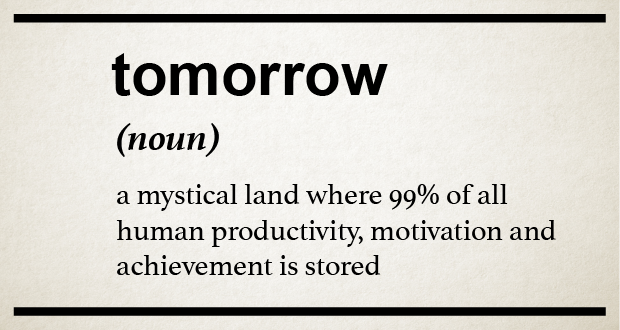
Procrastination comes from the Latin word 'procrastinatio' which has similar meaning. While the cause of procrastination in a psychology isn't fully understood it is believed that it stems primarily from the misjudgment on how much can be done in an allotted amount of time. This can lead to serious consequences such as staying awake until 4:00 a.m. studying for a math exam and then preparing for the history exam in the 2 hours given between exams.
Procrastination

Comments

Popular posts from this blog

Semester II Final

Part A: 1. Before doing any research, I predict the three most highly ranked presidents in US history will be: President Abraham Lincoln provided a way to create unity in the United States while progressing the moral values of the country. George Washington would likely be near the top of that list due to the work he put forward in creating the nation. Jefferson would also be considered a successful president after making the Louisiana perchance which vastly expanded US territory. and the worst might be, when evaluating by public opinion, are the most recent presidents due to the increasingly dividing political climate. Nixon is also remembered as one of the worst presidents due to his involvement in Water Gate. 2. According the the C-Span Survey  the presidents who are consistently in the top 4 are: Abraham Lincoln, George Washington, Franklin D. Roosevelt, and Theodore Roosevelt. While there were no two presidents who went back a forth in the 4th and 5th slots as Theodore ...

Source Use & Citation

1. From analyzing Bess' work with his sources, what standards or rules does he seem to be following for citing his work? During the first mention of a source he fully states: the authors first and last name, title of the work, publisher, and year of publication. When citing a source previously cited he shortens to last name, title, then page number; if the source is mentioned twice consecutively he uses 'Ibid' to shorten the citation even further. 2. Bess' work provides us with example of "Annotated" notes. (Examples: 3, 5, 6, 8, 11, 25). Based on these examples, what do you understand annotated to mean? Annotated in this context means to give credibility and specific relevance to the example used. 3. Are there sources in the notes that are not MENTIONED directly and explicitly in the text itself? If so, what rule seems to apply? How might he be making that determination? In note 8 he mentions Reading the Holocaust  and Morality after Auschwitz altho...